
Culture
Why Food Is Love (Especially in the Fourth Trimester)
Food is how we say the things words can't quite carry. In the fourth trimester, when asking for help is the hardest thing, a meal needs no translation.
- Food is the language we reach for when words aren't enough — casseroles for grief, cake for birthdays, a pot of something for a household in the thick of it.
- In the fourth trimester it matters more, because asking for help is the one thing a depleted mother can't easily do. A meal requires no asking.
- Postpartum traditions worldwide — zuo yuezi, jaappa, la cuarentena, sanhujori — all treat feeding the mother as a community job, not her own.
- We've largely lost that, and what it costs is the experience of being held during the most vulnerable season of your life.
- Receiving is the hard part. If someone offers a meal, say yes. If nobody's offering, it's fine to arrange it yourself.
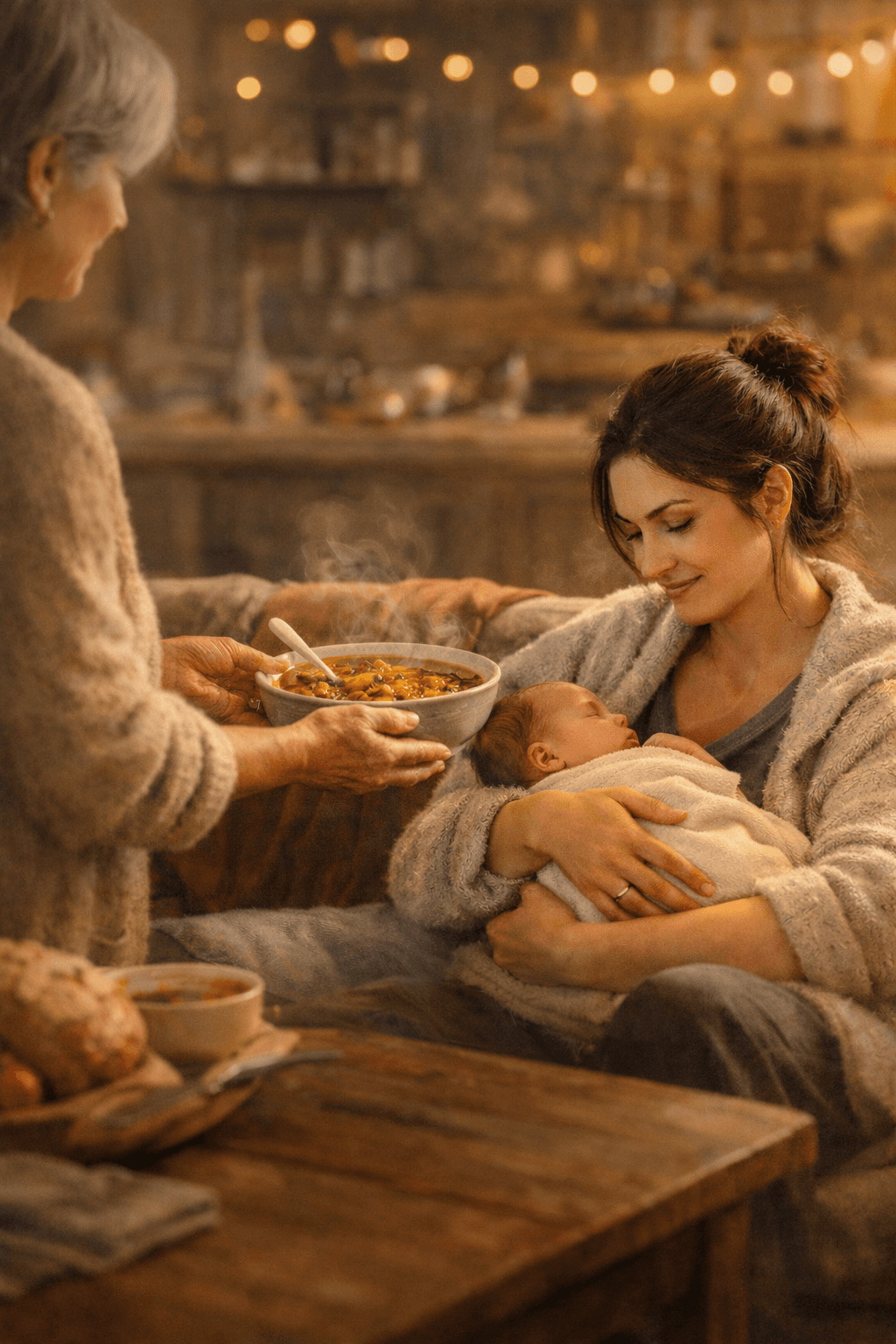
I had every intention of being cared for after my birth.
My birth plan said so in writing: two weeks in bed with the baby, no visitors, no cooking, no cleaning. Fourteen days. My birth was as crunchy as they come — at home, in my own bed, with a midwife I trusted completely.
Three days later I was standing in my kitchen making a frittata for a family brunch. Mother's Day had landed on the Sunday after I gave birth. I hadn't planned the brunch. I hadn't agreed to visitors. My partner's aunt, who I'd met exactly once, came into the bedroom to sit with the baby while I breastfed — a skill I had very much not mastered yet.
I tell that story because I had the plan, the midwife, the partner and boundaries I'd have called strong, and it still went that way. Nobody was unkind. It just turns out that in the absence of a culture that feeds new mothers, a new mother ends up at the stove.
Which is the whole reason a pot of soup arriving at the door hits the way it does. Somebody did the thinking, the deciding and the cooking, and then handed it over with nothing expected in return.
The language we use when words aren't enough
We've always used food to say the things words can't quite carry.
We bring casseroles to grieving families. We celebrate with cake. We sit down together on holidays not for the calories but because eating in the same room means something.
Food says: I care about you. You matter enough for me to spend an afternoon on this. I want to fill you up.
And in postpartum, when a mother is too tired to ask, too overwhelmed to explain and too depleted to do one more thing, food becomes a language that needs no translation.
Why it lands harder in the fourth trimester
There's something particular about this stretch that changes the math.
Postpartum is a season of real vulnerability. Your body is healing. Your hormones are in flux. Your sleep is in pieces. Your sense of who you are is shifting under you. And you're responsible for keeping a very small person alive, which has a way of filling every available inch of your attention.
In that season, receiving care isn't a luxury. But asking for it can feel impossible.
Part of that is cultural. We've absorbed the idea that a mother should manage it all, that needing help is a failure of some kind, that the good ones don't complain.
Part of it is practical. On two hours of sleep, you don't have the bandwidth to work out what help you need, let alone put it into a sentence and send it to someone.
And part of it is just human. When you're that depleted, asking for anything at all feels like more than you've got.
You don't have to ask for food to receive it. The giving has already happened. All you have to do is eat.
Your nervous system is in this too
There's a concept in psychology called co-regulation — the way our nervous systems settle in the presence of someone calm and attuned.
Babies do it instinctively. When they're distressed they reach for a caregiver, and the caregiver's steady breathing and warm body helps them come back down.
Mothers need it too. In the thick of newborn life, you're running hypervigilant, tuned to every sound, ready to move at any second. That's appropriate. It's also exhausting.
A warm meal that somebody else made is one of the plainest versions of that care there is. Something essential has been handled. You can put a bit of the vigilance down.
The traditions knew
In cultures around the world, postpartum has been treated as a community responsibility rather than a private one.
In China, zuo yuezi — "sitting the month" — is 30 to 40 days of rest, during which the new mother is fed warming foods, kept from strain, and not expected to do housework or leave the house.
In India, jaappa follows a similar shape, with particular warming foods, massage and very few visitors.
In Mexico, la cuarentena gives a new mother forty days of rest, food and family support.
In Korea, sanhujori centres on keeping her warm and well fed — seaweed soup, especially — and shielded from cold and stress.
These aren't relics of a less enlightened time. They're generations of accumulated sense about something modern life forgot: a mother who has just given birth needs mothering herself. And a great deal of that mothering is food.
You can read more about the first forty days across cultures if you want the long version.
What we lost, and what it costs
In modern Western life we've drifted a long way from all this. Families live scattered. Leave is short or nonexistent. The expectation is that a mother will be back to normal quickly and quietly.
And food became something we do instead of something we receive. We meal prep. We order the groceries. We work out what's for dinner. Even in the first weeks, when a body is asking loudly for rest, we end up at the stove because who else is going to be?
What that costs isn't just recovery time and energy. It's the experience of being held during one of the most tender seasons of a life.
I don't say that to make anyone feel guilty. Modern life is what it is. But there's something here worth taking back.
What it means to feed someone well
When I started making postpartum meals, I thought I was solving a logistics problem. New mothers don't have time to cook, so give them food that's already made. Simple.
The longer I've done it, the less it looks like logistics.
Every meal we make is a small act of care for someone I've never met. You don't have to figure this out. Someone thought about what you'd want. You're worth the trouble.
That's what food-as-love actually says, and every new mother deserves to hear it.
Letting yourself receive it
If you're reading this as a new mother, or about to be one, let me say this gently: you're allowed to receive care.
It might feel uncomfortable. You might feel you ought to be able to handle it, or guilty for accepting when it's offered.
The mothers who come through this best aren't the ones who did it alone. They're the ones who let themselves be held — by partners, family, friends, neighbors.
If someone offers to bring a meal, say yes. If someone asks what you need, tell them food. If you're building a registry or a support plan, put nourishment in the middle of it.
And if nobody's offering, it's completely fine to arrange it yourself. A freezer full of ready meals isn't indulgent. It's one of the most practical things you can do for the version of you who will be standing in that kitchen at eleven at night.
For more on what your body is actually asking for in this stretch, have a look at What Your Body Actually Needs Postpartum.
One small reframe
Every time you eat a nourishing meal in postpartum, you're taking part in the love, not just receiving it.
Whether it came from a friend, your mother, your partner or a delivery van, it exists because somebody cared enough to make it. Eating it is how you honor that. It's how you say: I'm worth this.
In a culture that tells mothers to give endlessly and receive nothing, feeding yourself well is a quiet act of rebellion.
"There is no love sincerer than the love of food."
— George Bernard Shaw
Topics
Share this to your Story
We'll make you an image that's already sized for it.
From the kitchen
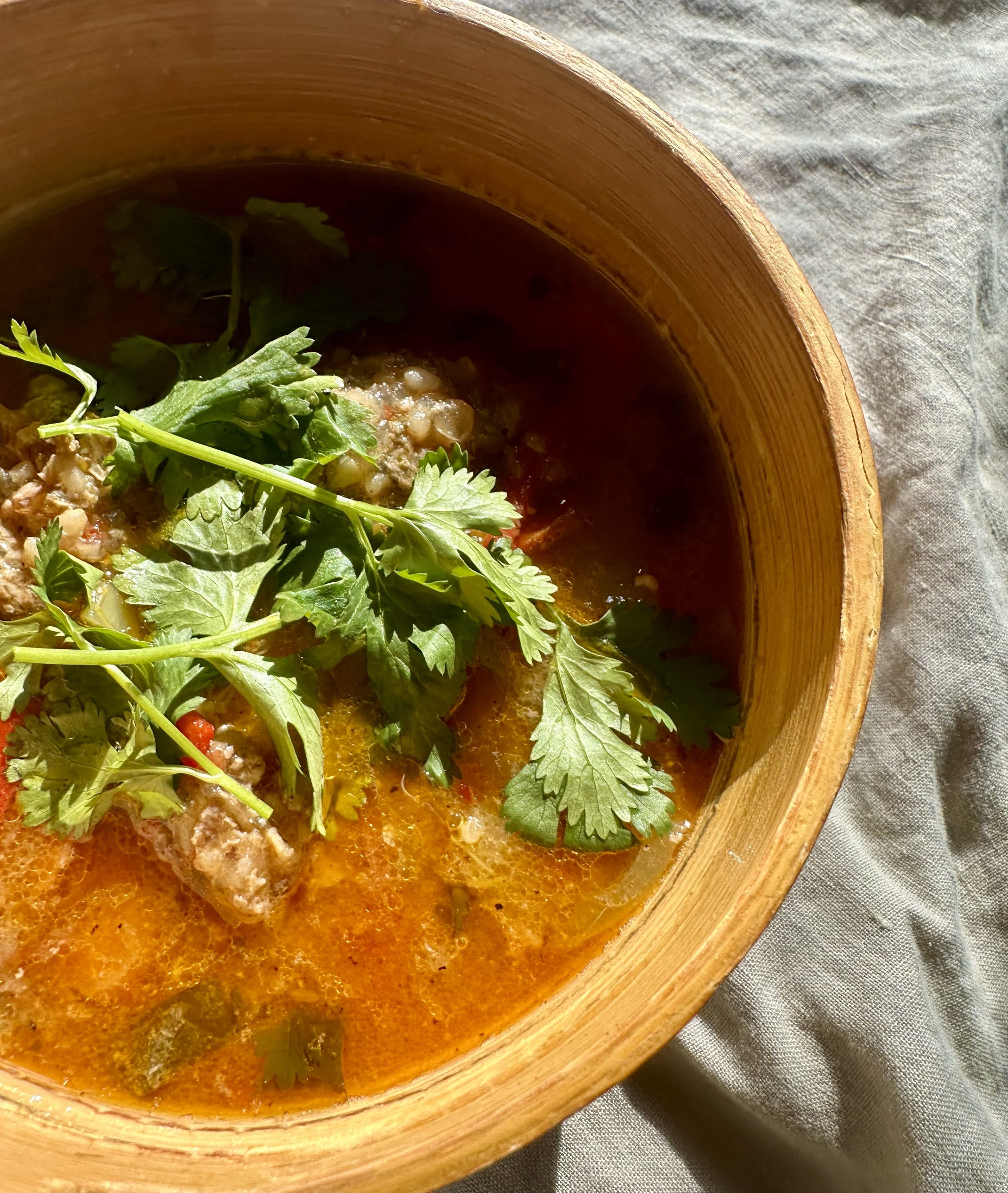
Ancestral Albondigas
Albondigas is a traditional Mexican stew of meatballs and vegetables in broth-- ours is catered specifically to postpartum mothers. We use a blend of grass-fed beef, beef heart and beef liver. The ratio matters: enough organ meat to give you concentrated nutrition, enough regular beef to keep the flavor rich and familiar.
Feeding someone who just had a baby?
We cook the meals and ship them frozen, so there is one less thing to figure out.