
Foundations
The First 40 Days—and Beyond: Why Postpartum Nourishment Matters (and Why It's Never Too Late)
The first forty days after birth deserve protecting. But life doesn't politely get easy on day 41 — and warm, grounding food belongs to anyone who needs restoring.
- Nearly every culture protects the first 30 to 40 days after birth in some form: stay close to home, stay warm, be fed consistently, don't do the dishes.
- The early window is real and concentrated. It's also not a deadline — support is never late.
- The support curve is upside down. Visitors and meals arrive in week one; weeks three to six are usually harder and quieter.
- Showing up in week four is the single most useful thing a friend can do.
- "Mothering food" — warm, grounding, already made — belongs to anyone who needs restoring, postpartum or not.

When I started thinking about writing this, I had the classic little internal debate. Do we talk about the "first 40 days" the way everyone does… or do we say the other true thing, which is that sometimes you're two years into parenthood and you still want someone to hand you a bowl of soup and tell you to sit down for five minutes?
Both are true.
There is something real about the early postpartum window. Across an enormous number of cultures, the weeks after birth are treated as a protected season — warmth, rest, simple routines, steady food. Not because someone invented a rule, but because people have been watching new mothers for a very long time and thinking, yeah, she shouldn't be doing the dishes right now.
And also: life does not politely get easy on day 41.
If you're reading this as a mother, it's not too late to be nourished. If you're reading this as someone who loves a mother, you're not behind. And if you're reading this as a regular human — single, elderly, burned out, recovering, living alone, living fast — sometimes you need what we call mothering food too.
Why forty days, and why it makes sense
The forty-day idea turns up everywhere. Different traditions name it differently — confinement, lying-in, sitting the month, la cuarentena — but the themes rhyme:
Stay close to home.
Stay warm.
Be fed consistently.
Don't strain.
Be held by people, ideally without having to ask.
It's a collective agreement that postpartum isn't a time to bounce back. It's a time to come back to yourself.
And whether a tradition says 30 days, 40 or 60, they're pointing at the same fact: early postpartum needs are concentrated. The body is recovering. Sleep is broken. Hormones are moving. A baby is learning to be a baby and a mother is learning to be a mother. Nothing about that is a performance season. You can read the long version in the first forty days across cultures.
It's a basics season, not an optimizing season
In the early weeks, most mothers aren't asking how to optimize anything. They're asking, quietly, how to get through today.
A newborn reorders life down to the foundations — sleep, food, water, warmth, safety, and support in the form she actually wants it. When those aren't steady, everything else gets harder.
Which is why "just eat something" can feel a bit laughable as advice. A new mother doesn't need more advice. She needs less friction between I need food and I have food. No chopping. No cleanup. No planning. Heat and eat.
Why being fed can feel like being held
There's a reason a warm meal can make someone cry, and it isn't only what's in the bowl.
A good meal says: you don't have to do everything, you're allowed to receive, I'm here even when I'm not in the room.
Postpartum can feel isolating even when the house is full of people. Sometimes it isn't loneliness exactly. It's the particular exhaustion of being needed constantly while nobody quite notices that you're also a person who hasn't eaten.
The support curve runs backwards
This is the part I wish we talked about more.
Support arrives like a wave — big, emotional, immediate. And then quiet.
Week one brings visitors, texts, flowers, excitement. Weeks three through six bring fewer check-ins, fewer meals, more reality, and the full accumulated weight of broken sleep.
If you're supporting someone, showing up in week four is a power move. A tender one.
So yes, the first forty days matter — and the back half of that window is often where food matters most, because the adrenaline has worn off and the work hasn't.
And it's never too late
The forty-day frame is useful because it tells the truth about how intense the early stretch is. But it can accidentally write a different story: well, we missed it, so now it's just normal life.
Except normal life, especially modern parenting life, is relentless. Two years in, you might be sleeping more. You're also carrying more logistics, more movement, more noise, more decision fatigue, and more "can you just—" than you were at six weeks.
A nourishing meal still matters there. Not as recovery food. As stability food. It can be the difference between eating something real and skipping dinner again. Between having patience left and having none.
And it isn't only parents. People living alone need real meals. Older people need them. People moving through grief, surgery, burnout, divorce, a hard stretch at work, caring for someone else — all of them need to be fed like somebody cares.
What mothering food actually means
We use that phrase a lot, and not because it's only for mothers. It's the kind of food that restores you.
Warm. Grounding. Made with intention. Easy to get to. The opposite of grabbing something. The opposite of eating standing up over the sink.
Match the support to the person
One of the most important parts of postpartum support — of any support, really — is that people want different things. Some want company and hands in the sink. Some want the food left on the step and the house left quiet. Both are entirely reasonable, and good support offers the choice instead of assuming.
If you're close enough to ask:
"I'd love to support you in a way that actually feels good. Would you rather drop-off meals and privacy, or meals plus a bit of help — dishes, laundry, holding the baby?"
If you're not that close, keep it easy to ignore:
"No need to reply. I'm sending food so you don't have to think about it. If you ever want company or a hand with anything, just say."
A 60-second checklist before you send food
If you can only ask one question, ask this: do you have freezer space right now?
If you can ask a few more:
Any dietary restrictions or strong aversions?
Is there a best day or time to deliver?
Drop-off only, or are short visits welcome?
Should I coordinate with your partner or whoever's helping?
That's the difference between care landing as relief and care landing as one more thing to manage. If you want the scaffolding to organize several people at once, we built a way to run a small village around one mother.
Nerding out, briefly
There's a reason so many traditions lean on warm, easy-to-eat food in postpartum. When sleep is broken and everything is demanding, most of us do better on simple, steady meals with real protein in them than on whatever can be assembled standing up.
Under-eating in postpartum is extremely common, and not because mothers don't know better. It's because time, energy and free hands are all in short supply. Making food easy to reach isn't extra. It's the foundation. (And yes, all of that applies to non-postpartum humans too.)
The bottom line
The first forty days is a powerful frame because it reminds us that early support is time-sensitive.
But nourishment is never wasted, support is never late, and mothering food belongs to anyone who needs restoring.
If you're reading this as a mother: you still deserve support. If you're reading this as someone who loves a mother: feeding her is still the most practical thing you can do. And if you're reading this as a person who could simply use a good meal, you're in reasonable company.
Sometimes the most useful thing you can do for someone is very simple. Feed them well.
— Monika
Topics
Share this to your Story
We'll make you an image that's already sized for it.
From the kitchen
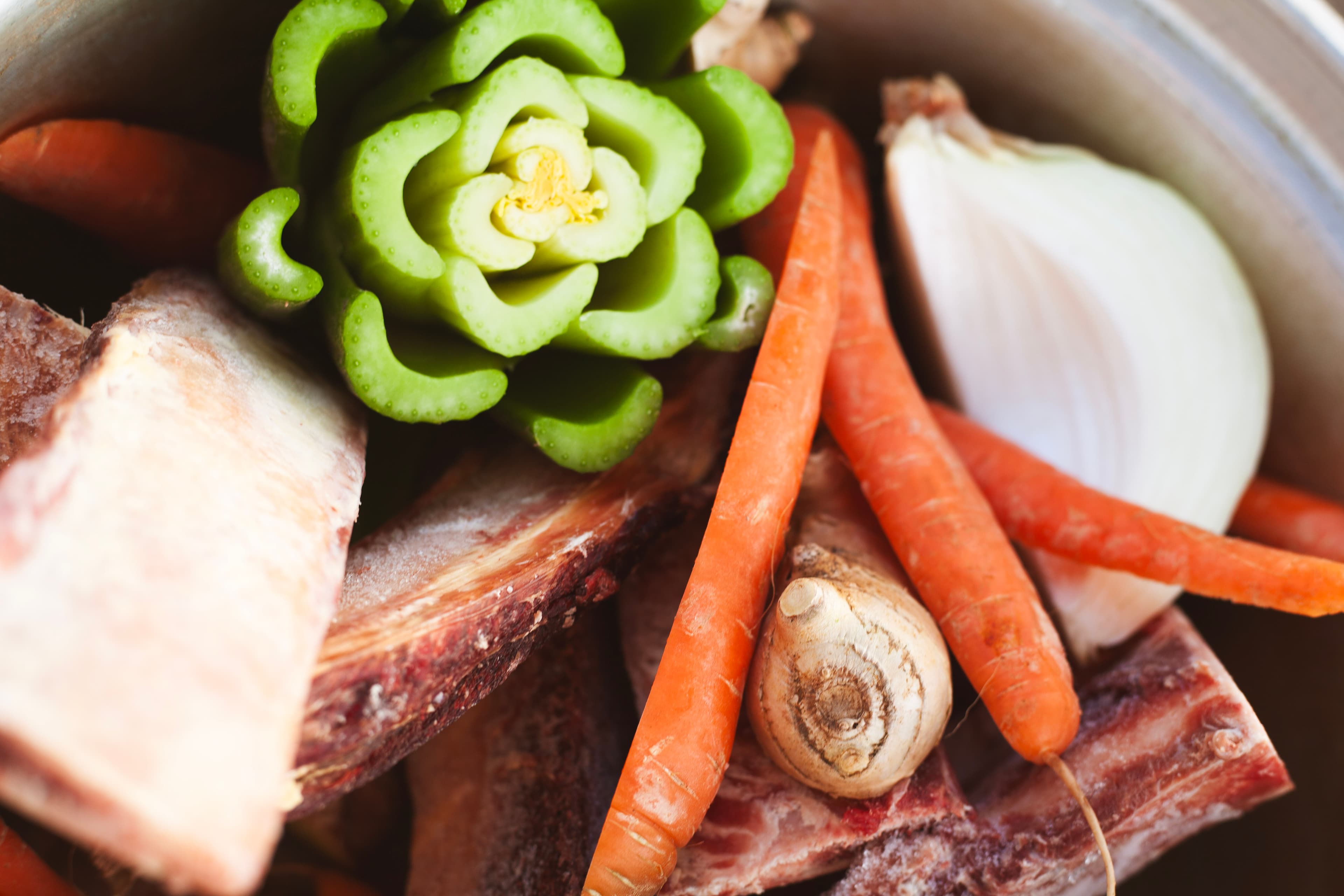
48-Hour Bone Broth
Organic, grass-fed beef bones plus organic carrots, celery, onions, garlic, and fresh rosemary = pure postpartum magic. A splash of organic apple cider vinegar before the 48-hour simmer allows for maximum mineral extraction, making calcium, magnesium, and phosphorus available in a form your body can actually absorb when you're depleted.
Feeding someone who just had a baby?
We cook the meals and ship them frozen, so there is one less thing to figure out.