
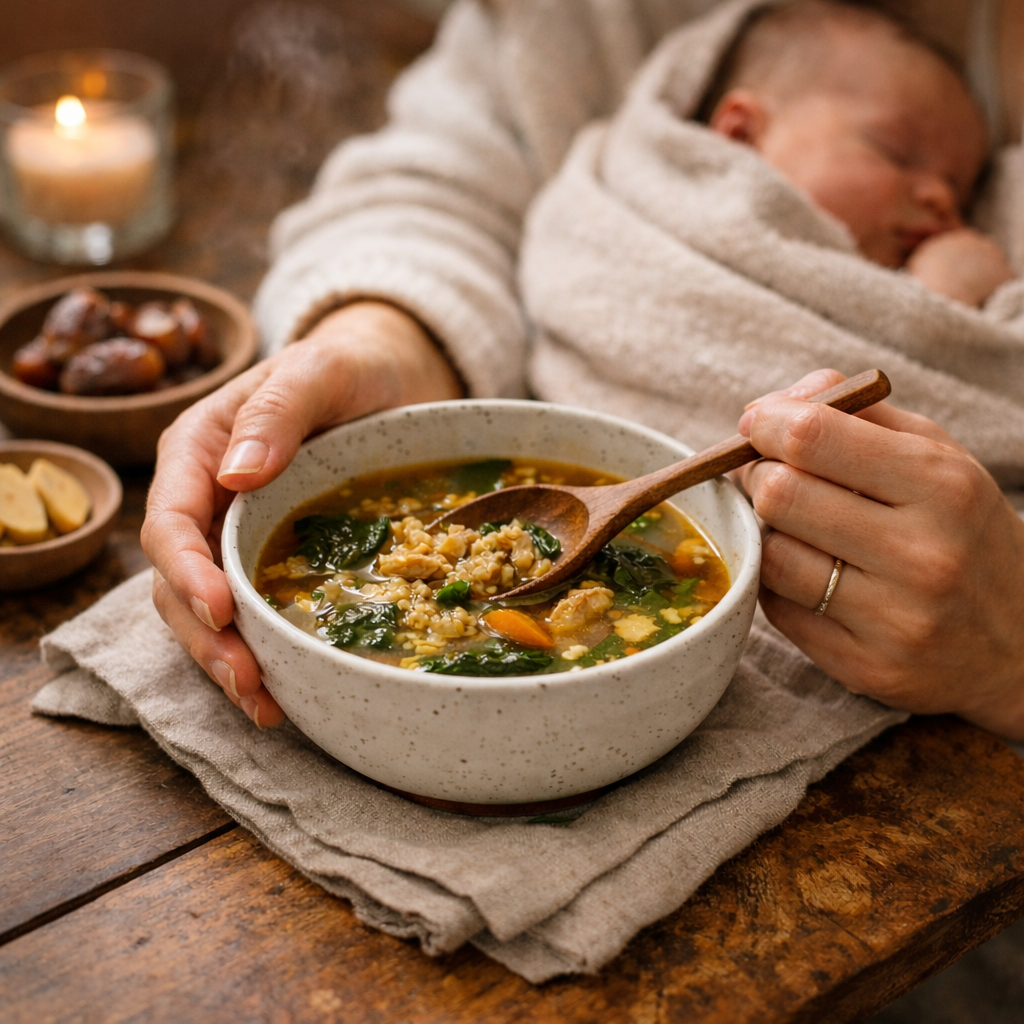
The First 40 Days—and Beyond: Why Postpartum Nourishment Matters (and Why It's Never Too Late)
By MothershipJanuary 1, 20268 min read
When I started thinking about writing this, I had the classic little internal debate: do we talk about the "first 40 days" like everyone does… or do we say what's also true, which is: sometimes you're two years into parenthood and you still want someone to bring you a bowl of soup and tell you to sit down for five minutes.
Both are true.
There is something real about the early postpartum window. Across so many cultures, the first weeks after birth are treated like a protected season—warmth, rest, simple routines, and steady nourishment. Not because someone once made up a rule, but because people have been watching what happens to new mothers for a very long time and thinking, "Yeah… she shouldn't be doing the dishes right now."
And also—life does not politely get easy after day 40.
If you're reading this as a mother: it's not "too late" to be nourished.
If you're reading this as someone who loves a mother: you're not behind.
And if you're reading this as a regular human—single, elderly, burned out, recovering, living alone, living fast—sometimes you need what we might call mothering food too.
Warm, grounding meals that restore you. Not because you're fragile. Because you're alive.
stay close to home
stay warm
be fed consistently
minimize strain
be held by community (ideally without having to ask)
It's basically a collective agreement that postpartum is not a time to "bounce back." It's a time to come back to yourself.
And whether your tradition uses the number 30, 40, or 60, the wisdom is pointing at the same thing: early postpartum needs are concentrated. The body is recovering. Sleep is broken. Hormones are shifting. A baby is learning how to be a baby. A mother is learning how to be a mother. This is not a performance season. This is a support season.
Sleep (fragmented)
Food (often skipped)
Hydration (forgotten)
Warmth & comfort
Safety (physical + emotional)
Support (in the way she actually wants it)
This is why nourishment becomes time-sensitive early on: if those basics aren't steady, everything else gets harder.
repairing tissue
replenishing nutrients after pregnancy and birth
stabilizing blood sugar under stress and sleep disruption
adjusting hormones
regulating a nervous system that's on-call 24/7
and, for many mothers, producing milk—which is its own ongoing energy demand
This is why "just eat something" can feel… laughable. Because postpartum isn't a time when a mother needs more advice. She needs less friction between "I need nourishment" and "I can access nourishment."
No chopping. No cleanup. No planning. Just: heat and eat.
"You don't have to do everything."
"You're allowed to receive."
"I'm here—even when I'm not physically present."
That's co-regulation in real life: the nervous system relaxing because something essential has been handled.
And it matters because postpartum can feel isolating even when people are "around." Sometimes it's not loneliness. Sometimes it's the particular exhaustion of being needed constantly… while no one is noticing that you're also human.
more logistics
more movement
more noise
more decision fatigue
more "Can you just…?" all day long
A nourishing meal still matters, not as "recovery food," but as stability food.
It can be the difference between eating something real or skipping dinner again. Between being patient or being on the edge. Between feeling steady or feeling like you're held together by coffee and willpower.
And it's not just parents.
Sometimes single guys need a nourishing meal. Elderly people need nourishing meals. People living alone need nourishing meals. People going through grief, surgery, burnout, divorce, overwhelm, depression, work stress, caretaking… need nourishing meals.
In other words: sometimes we all need to be fed like someone cares.
Any dietary restrictions or strong aversions?
Is there a best delivery day/time?
Drop-off only, or are short visits welcome?
Should I coordinate with your partner/support person?
This is how care lands as relief instead of another thing to manage.
"Eat bread and understand comfort. Drink water, and understand delight." — Mary Oliver
Why the first 40 days gets emphasized (and why it makes sense)
The "40 days" idea shows up in a lot of places. Different traditions name it differently—confinement, lying-in, "sitting the month," la cuarentena—but the themes rhyme:The honest truth: postpartum is a hierarchy-of-needs moment
In the early weeks, most mothers aren't thinking, "How can I optimize?" They're thinking (often silently), "How do I make it through today?" A newborn reorders life around the basics:What's happening in a mother's body (and why food actually matters)
Postpartum isn't just "busy." It's a full-body recovery period. A mother's body is doing a lot at once:Co-regulation: why being fed can feel like being held
There's a reason a warm meal can make someone cry—especially postpartum. Nourishment isn't only biochemical. It's relational. A good meal says:The hidden curve: support often drops right when fatigue builds
This is something I wish we talked about more. Support tends to arrive like a wave: big, emotional, immediate. And then—quiet. The first week might come with visitors, texts, flowers, excitement. Weeks 3–6 often come with fewer check-ins, fewer meals, more reality, and the accumulated effects of sleep deprivation. So yes, the first 40 days matter—and in many households, the later part of that window is where nourishment becomes even more important because the adrenaline has faded and the workload hasn't. If you're supporting someone: showing up in week four is a power move. A tender one.And now the other truth: it's never too late to nourish
Here's where we widen the lens. The "first 40 days" is a helpful frame because it tells the truth: early postpartum is intense and deserves protection. But it can accidentally create this story: "Well… we missed it. So now it's just normal life." Except—normal life, especially modern parenting life, can be relentless. If you're two years into parenthood, you may be sleeping more than in newborn days (maybe), but you're often carrying:"Mothering food" (for mothers, and for anyone who needs it)
We use this phrase a lot: mothering food. Not because it's only for mothers. Because it's the kind of food that restores you. Warm. Grounding. Made with intention. Easy to access. The opposite of "grab something." The opposite of "figure it out." The opposite of eating standing up over the sink. Mothering food is what you eat when you want your body to feel safe again.A note on preferences: support should match the person
One of the most important parts of postpartum support (and honestly, human support in general) is this: Some people want company and hands-on help. Some people want privacy and quiet. Both are valid. The best support doesn't assume—it offers options. If you're close enough to ask, here's a script that works:"I'd love to support you in a way that feels good. Would you prefer drop-off meals + privacy… or meals + a little help (dishes, laundry, baby hold)?"If you're not that close, keep it gentle:
"No need to reply fast. I'm sending nourishment so you don't have to think about food. If you ever want company or practical help, I'm here—just say the word."
A 60-second checklist for sending nourishment (postpartum or otherwise)
If you can ask one quick question, ask this: "Do you have freezer space right now?" If you can ask a little more:Nerdin' Out (just a little)
There's a reason so many traditions lean on warm, easy-to-digest foods in postpartum. When sleep is disrupted and stress is high, the body tends to do better with simple, steady nourishment—meals that don't spike and crash you, that include real protein, minerals, and enough calories to actually support repair and (for many) milk production. Also: postpartum depletion is real. Pregnancy and birth ask a lot. Under-eating postpartum is incredibly common—not because mothers don't know what to do, but because time, energy, and hands are limited. Making nourishment easy is not "extra." It's foundational. (And yes, you can apply all of that to non-postpartum humans too.)Bottom line
The first 40 days is a powerful frame because it reminds us: postpartum support is time-sensitive, and early nourishment matters. But nourishment is never wasted. Support is never late. And "mothering food" belongs to anyone who needs to be restored. If you're reading this as a mother: you still deserve support. If you're reading this as someone who loves a mother: feeding her is still one of the most practical ways to help. And if you're reading this as a human who could use a nourishing meal: you're not alone. Sometimes the most profound thing you can do for someone is simple: Feed them well."Eat bread and understand comfort. Drink water, and understand delight." — Mary Oliver
Topics
postpartum nourishmentfirst 40 daysfourth trimestersupport giftsnourishing mealscare in hard seasonsmothering food
Share to your Story
Get a beautiful pre-made Story image ready to post!
Ready to support a new mom?
Send nourishing postpartum meals that make a real difference.